Ortler Hintergrat | 3849m
| Elevation gain |
| Elevation loss |
| Distance |
| Duration |
| Highest altitude |
| Rating |
Route Information
Ortler (3905m) is the highest mountain of Tirol. In German this mountain is often referred to as "König Ortler" (King Ortler). The massive mountain is capped by a glacier on the northwest flank and has a long north ridge that ends at the village of Gomagoi and separates the valleys of Trafoi and Sulden [wikipedia].
Ascent: Ortler is considered as one of the most important peaks of Eastern alps. All routes to the summit are challenging climbs. The Hintergrat route from Hintergrat hut is rated as AD (UIAA IV) and has mixed climb including climb on glaciated terrain with steepness up to 40 degree (topo). The route can be divided into three parts:
To Hintergrathütte: The hut can be reached from Sulden. You always have to follow the signs towards Hintergrathütte. The path is well marked and technically easy (T3). Usually it takes around 2-2.5 hours from the valley.
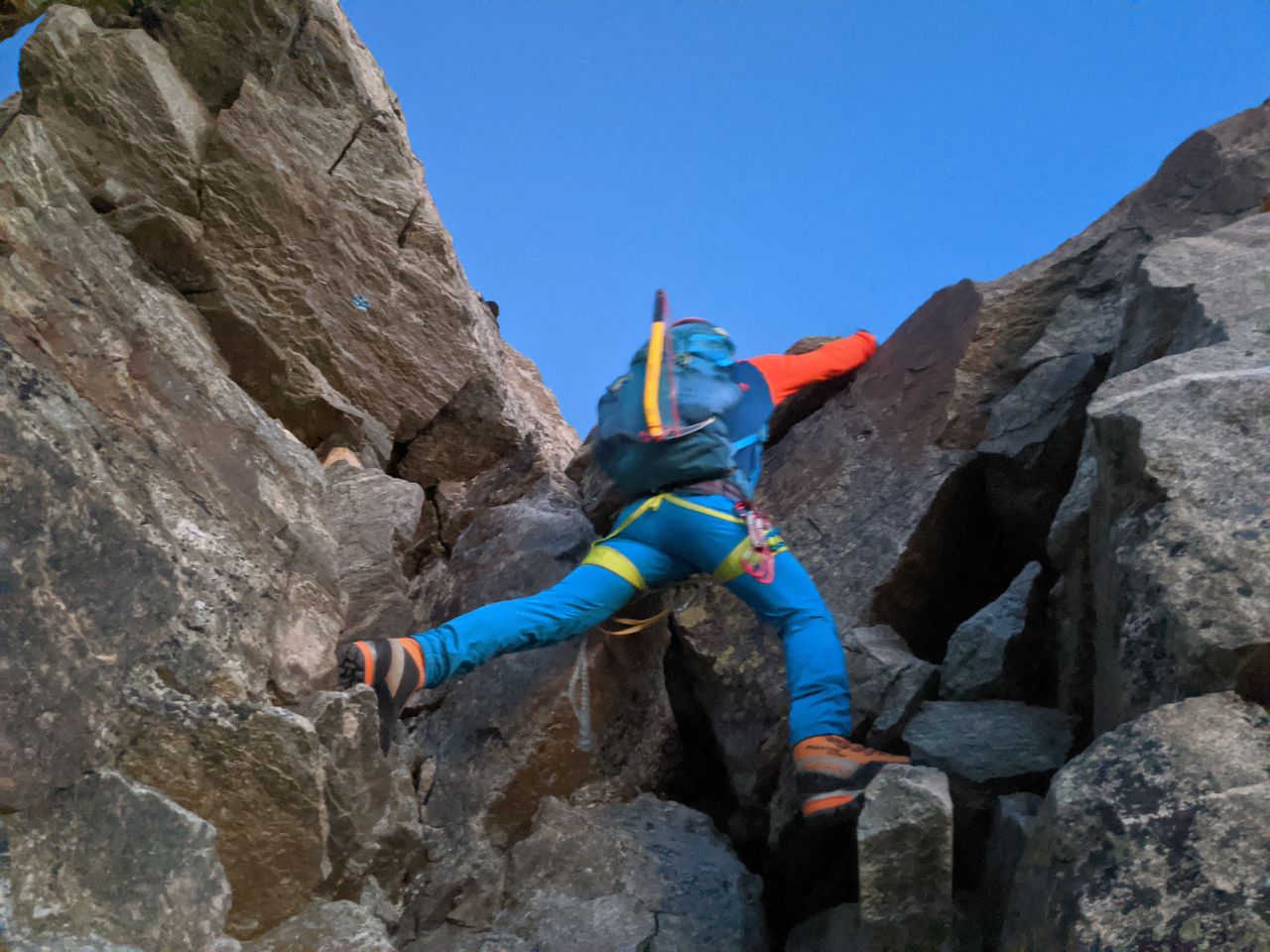
From Hintergrathütte to Signalkopf: From the hut follow the path on the East towards Gletscherweg. At the signpost around 2,700m leave the marked path to Gletscherweg on the right. Now the path finding becomes very difficult, although there are cairns which you can follow. After few scrambling sections (grade I-II), you arrive at the first snowfield. Now you mostly climb on the ridge at first mostly grade I scrambling but just before Signalkopf, the ridge becomes very exposed. From Signalkopf you can rappel on a ring.
From Signalkopf to Ortler: After Signalkopf, the rest of the climb is very technical and sometimes exposed, followed by a steep snowfield. After the snowfield, there are few technical sections and then easy scrambling to the summit.
Descent: Normal route
Webcams: Passo Stelvio
Interesting facts: 1. The ortler alps were one of the main battlefields between Italy and Austria. Austrian army had quickly occupied the highest peaks and Italian army kept trying to dislodge them for four years [wiki].
2. The first ascent had been a request of Archduke Johann of Austria. The archduke ordered Johannes Nepomuk Gebhard, a "mountain official" and topographer from Salzburg, to climb the mountain with locals. The first five attempts failed and Gebhard was ready to give up, when Pichler responded to the prize money offered for reaching the peak. Pichler and his friends took a difficult, and because of avalanche danger until recently disused, route over the northwest face from Trafoi. Upon their return, the men were not believed on their words alone. Gebhard sent Pichler onto the mountain twice more, first in August 1805 with a flag that could be observed with a telescope from the valley, and again in September 1805 with a huge torch. Only after the torch had been seen burning at night was the accomplishment acknowledged [source wikipedia].
| Technical Difficulty | Very Difficult | |||||||||||
|---|---|---|---|---|---|---|---|---|---|---|---|---|
| Gear | Hiking Boots , Hiking Poles , Helmet , Gloves , Ropes | |||||||||||
| Popularity | 2 | |||||||||||
Route statistics
| Highest point | 3849m | |||||||||||
|---|---|---|---|---|---|---|---|---|---|---|---|---|
| Total gain | 2150m | |||||||||||
| Total loss | 2162m | |||||||||||
| Duration | 12h35m | |||||||||||
| Distance | 21.0Km | |||||||||||
| Rating | 2660 | |||||||||||
Best Season
Forecast
Author