Hochkalter | 2608m
| Elevation gain |
| Elevation loss |
| Distance |
| Duration |
| Highest altitude |
| Rating |
Route Information
Hochkalter (2,608 meters) in the Berchtesgaden Alps is the highest peak in the massif of the same name and therefore one of the highest mountains in Germany. The Hochkalter Massif (German: Hochkalterstock or Hochkaltermassiv) is also called the Hochkalter mountains (German: Hochkaltergebirge).
The Hochkalter massif lies west of the Watzmann massif and, like it, is located within the Berchtesgaden National Park. The most important base for climbing this alpenstock is the German Alpine Club's Blaueis Hut (Blaueishütte, literally "Blue Ice Hut") which lies at a height of 1,653 metres (5,423 ft) in the Blaueis Cirque (Blaueiskar) below the Blaueis, which used to be the most northern glacier in the Alps [wikipedia].
The ascent to the ridge leading to Kleinkalter and Hochkalter via Schöner Fleck involves UIAA grade II scrambling. The route through Ofental reaches grade I. Ofental, though easier, is not recommend for ascending as there are a lot of scree fields which would be cumbersome to ascend.
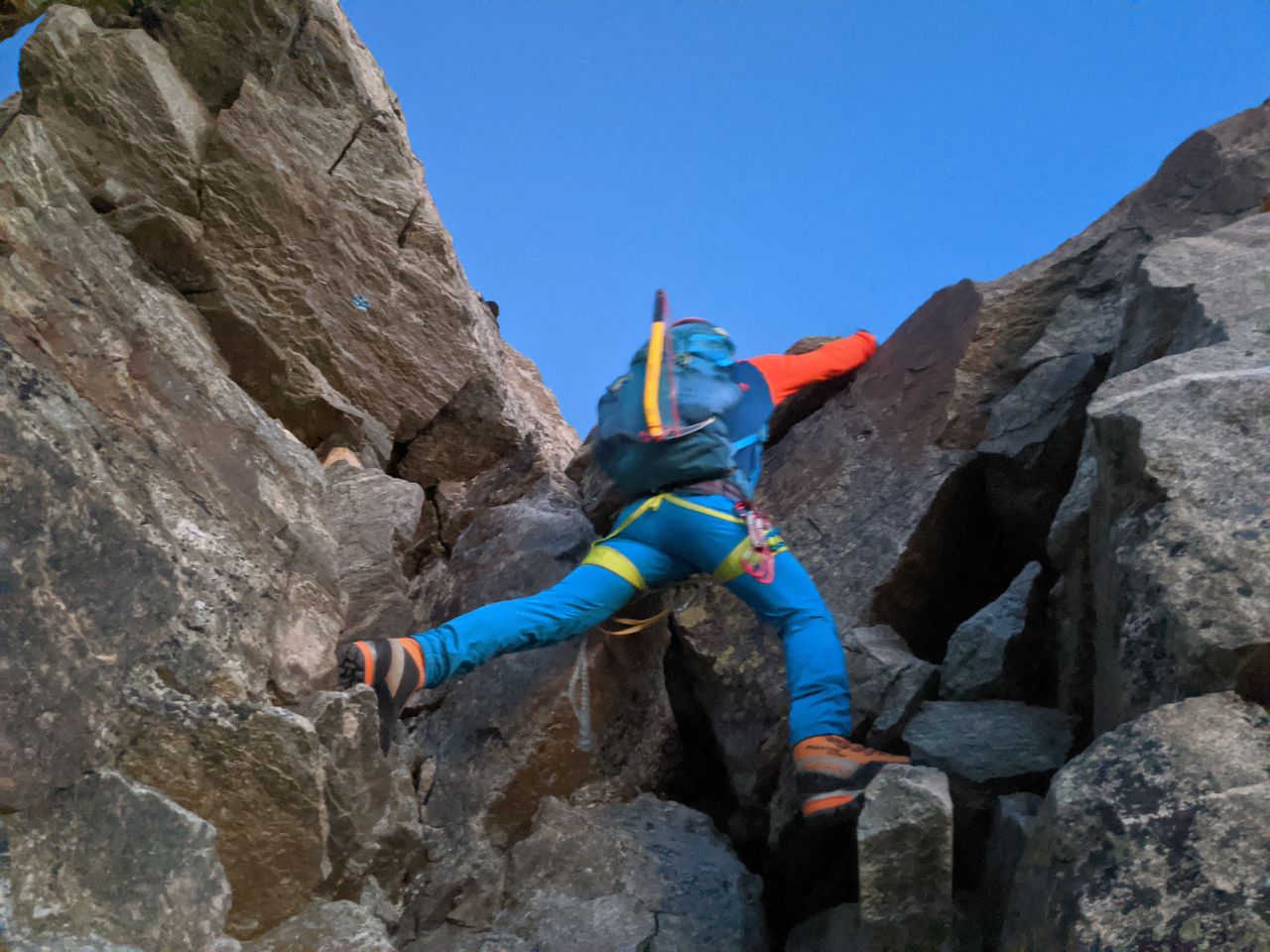
Ascent: Start from the free Parkplatz Hintersee (not Seeklause where you have to pay 5€/day). From there first ascent along a broad forest road towards Blaueishütte, and ascend towards Schöner Fleck across the steep couloir with scree. At the end you will encounter the first difficulty, a steep wall with firm rock and grade II climbing.
Descent: Continue across the ridge (follow red dots on white ground) towards Hochkalter and descend via Ofental back to the parking. The descent through Ofental requires a good sense of orientation, there are also several scree slopes. It is definitely preferrable to ascend via Blaueihütte and Schöner Fleck. On a hot day, you can go for a swim in Hintersee (very cold!).
Helmet (danger of rock fall in the couloirs)
Trekking poles for the descent
This route involves some exposed scrambling (UIAA II). Only for very experienced hikers.
Large rockfalls occurred time and again on the Hochkalter massif. In prehistoric times – around 3,500 years ago – more than 15 million m³ of rock slid from the upper Blaueis Combe into the valley. These rockslides impounded the lake of Hintersee. Even today the large glacial erratics in the Zauber Forest bear witness to this monumental event. But even in recent times there have frequently been large rock-falls:
- On 24 August 1908 the summit of the Hochkalter came crashing down and changed the appearance and height of the peak markedly. The volume of rock broken off is estimated at 240,000 m³. The rock fall was felt in the Ramsau valley as an earthquake.
- On 25 July 1954 the second Blaueis pinnacle on the northern arete of the Blaueisspitze collapsed.
- Nine years later to the day, on 25 July 1963, the collapse of a column on the Schärtenspitze resulted in the route up the north face becoming much more difficult.
- In February 1959 several hundred thousand cubic metres of rock slid from the area of the Palfelhörner onto the snow below in the upper reaches of the Wimbach valley. The brittleness of the rock in the Wimbach valley is very obvious. The floor of the valley is covered by streams of debris of great depth. This magnificent landscape may be experienced by anyone who walks from Ramsau (Wimbach Bridge car park) along the valley, initially through the Wimbach Gorge and then onto the open valley floor (about one hour to the Wimbachschloss Inn, a further hour to the Wimbachgries Hut, 1,327 m).
| Technical Difficulty | Difficult | |||||||||||
|---|---|---|---|---|---|---|---|---|---|---|---|---|
| Gear | Hiking Boots , Hiking Poles | |||||||||||
| Popularity | 5 | |||||||||||
Route statistics
| Highest point | 2608m | |||||||||||
|---|---|---|---|---|---|---|---|---|---|---|---|---|
| Total gain | 1814m | |||||||||||
| Total loss | 1816m | |||||||||||
| Duration | 08h03m | |||||||||||
| Distance | 15.0Km | |||||||||||
| Rating | 1678 | |||||||||||
Best Season
Forecast
Author