Teufelsgrat | 2744m
| Elevation gain |
| Elevation loss |
| Distance |
| Duration |
| Highest altitude |
| Rating |
Route Information
Teufelsgrat is the ridge in Wetterstein range between Teufelskopf and Hochwanner offering great views of almost all well known ridges of Wetterstein (Jubilaumsgrat, Blassengrat etc), Mieminger chain as well as Reintal and Gaistal valley. The ridge almost entirely lies on the border between Germany and Austria separating Reintal Valley in Germany from Gaistal Valley in Austria.
The ridge difficulty is mainly UIAA III, with the exception of a few III+ smaller sections. However, what makes this ridge extremely challenging is the extreme exposure on both sides combined with the very brittle nature of rock almost throughout the ridge, which runs approximately 3km. Apart from the rappelling sections there are no reasonable safety options, so it is better to walk rope free on the ridge.
We can split the entire tour into the following sections:
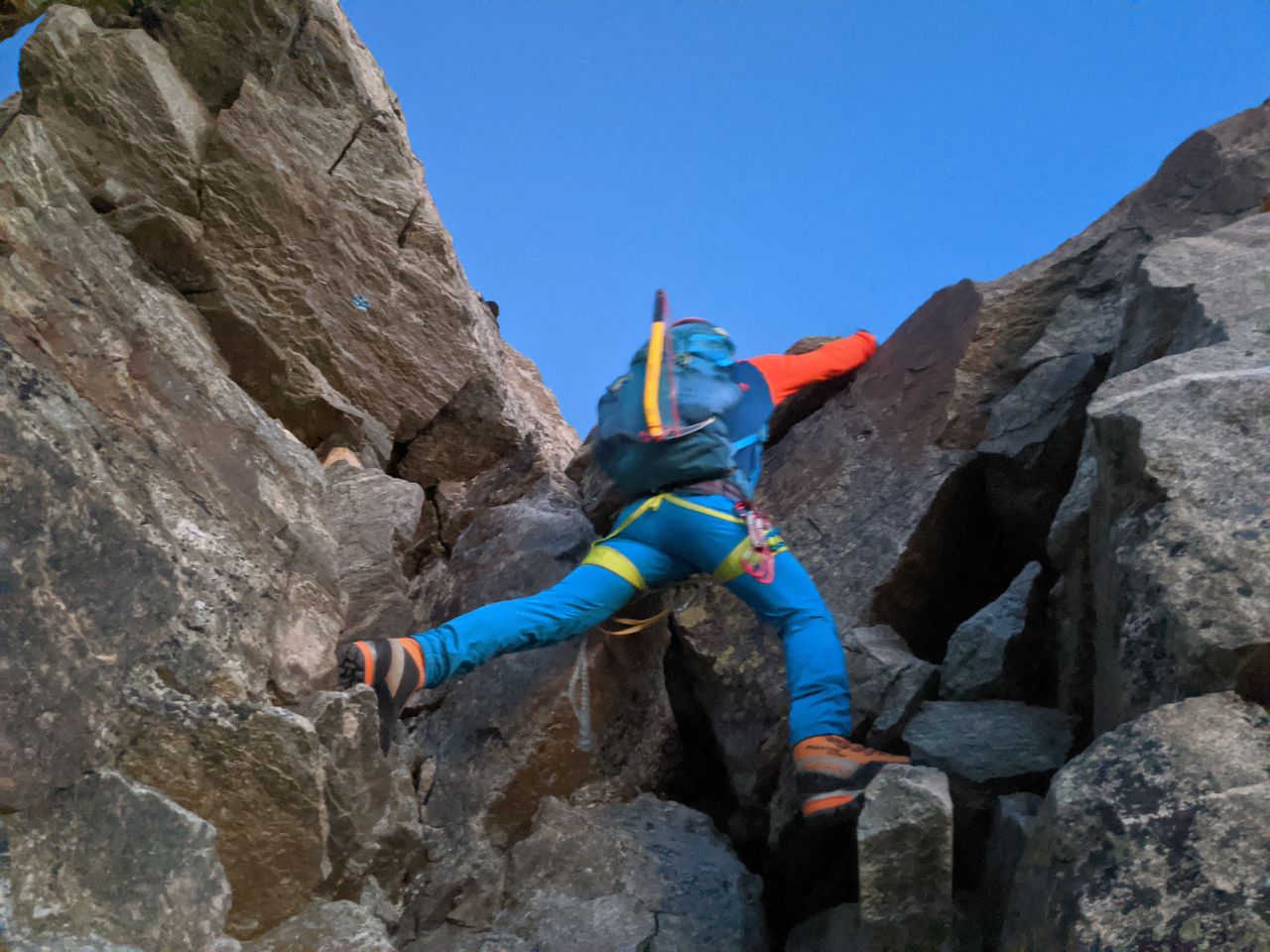
Parking lot to Teufelskopf: From the parking lot, there is a marked trail to Wettersteinhuette, and then to Wangalm. The route first runs along a wide mountain path, and then turns into a forest path. This is a T2 level hike, and can be done in the dark, in case you want to start early and have more time for the ridge. From the Wangalm you can see the twin peaks Oberreintalschrofen and Scharnitzspitze. Teufelskopf is to the left of these peaks and is barely visible from Wanglam. We follow the trail towards Rotmossalm in the beginning. At around 2034 meter height we reach a saddle known as Telfer Leger. Here we leave the trail, and turn right on a grassy ridge. There is no trail, but one can walk in the general direction of Teufelskopf. This slope is a bit steep, but the difficulty never exceeds T3. Once we reach the rock, we follow a chimney, which is full of rubble. The chimney requires UIAA II climbing, but the rubble makes it more annoying. After overcoming the chimney, keep walking up until the ridge is reached. Here, we turn left and after a few meters Teufelskopf is reached. One needs to be careful of the rubble as the route is relatively steep.
Teufelskopf to Obern Hundsstallkopf:
One can either stay on the ridge or go down a bit and then continue towards Obern Hundsstallkopf. Some towers are bypassed on the left, and some are tackled directly. This part is relatively easy (UIAA II), and the rock is also less brittle compared to the rest of the ridge. However, rubble still makes footholds less stable
Obern Hundstallkopf to Hinterreintalschrofen:
This is the longest section of the ridge and is full of towers and spikes. You have to use your own judgement about which ones to climb and which ones to bypass. The rock quality is probably the best on the top of the ridge and also on the north side. However, on the south side rock is very crumbly, so it's better to stay on the ridge as much as possible. The ridge becomes progressively airy and difficult as we go further. There are two spots where an abseil option is available. The first one is a bit longer, and is preferable to abseil, while the second one is shorter, and can be climbed down on the north side (fairly exposed though). The climbing difficulty in this section is mostly under UIAA III, except one small 10 m section of UIAA III+ (also in brittle rock).
At Hinterreintalschrofen, there is a summit cross made of wood, and is partially damaged. This is approximately the midpoint of the ridge. This is also the only point where it is possible to exit the ridge - There is a T4 (I) path from here to Rotmossalm.
Crawling section (Jungfernkar):
There is a relatively easy section that follows Hinterreintalschrofen and feels like a breather. It might be a good idea to take a small break here as the next section of the ridge requires utmost concentration - The highlight of the ridge is the crawling section. Here the ridge becomes knife sharp with extreme falls on both sides. One has to traverse this section very carefully, which sometimes requires crawling and sometimes riding the ridge like a horse. The climbing difficulty of this 150-200m long section is mostly UIAA 2+, however there are also UIAA III climbing sections. No mistakes are allowed in this section without serious accidents.
Crumbling rock section to Hocwanner pre-summit:
Once the crawling section is over, the extreme exposure on the north side is lessened. However, the rock quality degraded very rapidly here. Almost every rock is loose, which makes this section one of the most dangerous sections. There are climbing sections of UIAA III, which should be handled slowly and carefully.
Hochwanner pre-summit to Hochwanner:
After the pre-summit, the difficulties are mostly over, and this section feels like bread and butter after the previous two sections.
After the pre-summit, the difficulties are mostly over, and this section feels like bread and butter after the previous two sections.
Descent:
From Hochwanner, there is a marked trail to go down, which first runs on a gravel field, and then on a forest path. The difficulty of the descent never exceeds T3, however, hiking boots are still required for the gravel section near the top.
Automatic direction calculation (experimental feature, please provide feedback)
By car: Navigate using Google maps
By public transport:
Train station near start point: Oberhofen im Inntal (6.9 Km from start point)
Bus stop near start point: Gaistal/Salzbach (671 m from start point)
Ref : Gaistal/Salzbach
------
Automatic hut detection (experimental feature, please provide feedback)
Wetterstein Hütte (1717 m):
Website: Homepage
Phone: +436644153747
Wikipedia: Wikipedia page
Location: Google maps
Wangalm (1751 m):
Website: Homepage
Phone: +4352146620; +4366473863164
Location: Google maps
------
| Technical Difficulty | Medium Difficult | |||||||||||
|---|---|---|---|---|---|---|---|---|---|---|---|---|
| Gear | Hiking Boots , Hiking Poles , Helmet , Ropes | |||||||||||
| Popularity | 0 | |||||||||||
Route statistics
| Highest point | 2744m | |||||||||||
|---|---|---|---|---|---|---|---|---|---|---|---|---|
| Total gain | 1831m | |||||||||||
| Total loss | 1831m | |||||||||||
| Duration | 11h00m | |||||||||||
| Distance | 23.2Km | |||||||||||
| Rating | 1697 | |||||||||||
Best Season
Forecast
Author