The Klettersteig - 6 important points every hiker should know!
- Cosmin
- Sept. 25, 2020
For the mountain enthusiasts who are always looking for adventures there is a next level in hiking: its name is “the Klettersteig” or “the Via-ferrata”. As for any challenging adventure, you have to be aware of the risks involved in this activity and understand that there is a price to be paid to belong to this distinct group of hikers: you need to always have the will to conquer your fear, always push towards your goal, and of course always enjoy the ride.
Whether you are a beginner or an experienced hiker, the organiser or just a participant, you need to take into account some requirements to be safe, to protect others, and to have an amazing trip.
Be aware that your tour starts with the preparation, during which there are some important points to consider:
1. Route and conditions - which route is the right one?
Everybody should know that to reach a certain Klettersteig you have to hike a bit; that means you don’t have to use all of your energy before the starting point. Be aware about the length of the route, to know exactly how much hiking you have to do before and after the actual Klettersteig. Is your fitness level good enough to complete the route?
To help climbers identify which route is the best for them and to understand the difficulty, each route is marked using “the International Scale”: A - easy to E - extremely difficult (the route’s indicator is placed right after the name of each route).
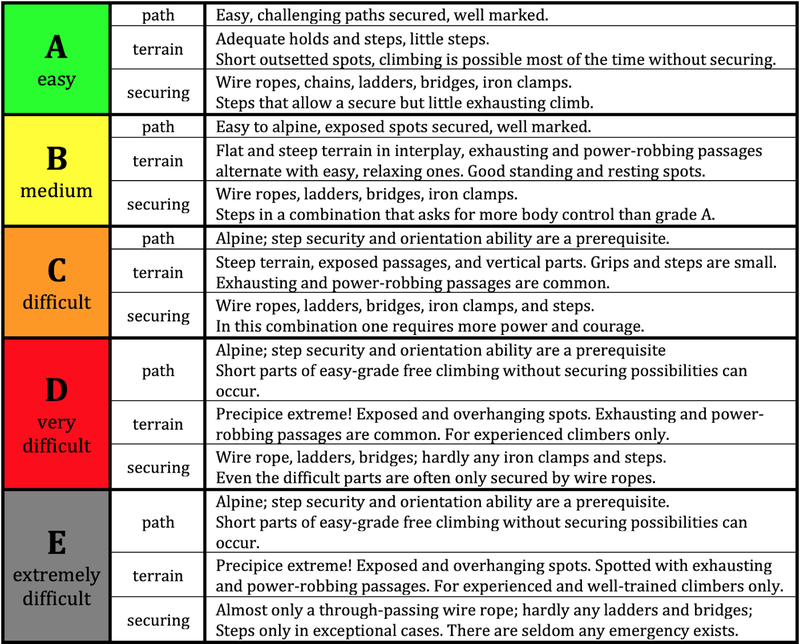
It is also very important to know if there are some resting places - intentionally designed places where you can catch your breath a bit, drink something, have a little snack, or maybe take some pictures. On difficult routes, starting with C and D, there are even emergency exists on the way, to help climbers reconsider the tour.
When you plan your tour, the position to the sun plays also a crucial part. Therefore, you should know exactly when the actual Klettersteig will be reached (in the morning or in the afternoon), as an East wall is totally different that a West one (slippery stones, cold temperature, or too much sun).
A good place to inform yourself is the Internet and nowadays a lot of websites offer support for most tours – before starting, download the gpx map and the topo for the selected route.
At the beginning of the season you should also consider, if the Klettersteig is in alpine environment, if the route is open and has been already verified. Is snow still there?
Very important notice: Do not go into closed routes! Every route is verified by qualified personnel on a fixed period. If the route is marked as closed, it means that a specialist had important reasons to close the route to the public: it my have missing parts, some sections may be under construction/replacement, or the environment might not permit a safe passage.
2. Weather – inform yourself in advance about the weather conditions
On a normal hike one can return in case of bad weather, but on a Klettersteig the situation is a bit more complex. If the route is wet, if it’s cold, or if the wind is very strong, the chance of falling is increasing.
Consider also that a Klettersteig is a giant electricity-conducting system and a lightning strike puts your life in danger.
In case of rain do not let go of the metal wire! Do not unclip yourself! Search for the immediate exit and use it.
3. Equipment – the proper gear
Mandatory gear:
- harness (waist or combi);
- Klettersteig-set with energy-absorbing system;
- helmet: it protects you from stones that fall or protects the head from unwanted wall strokes;
- gloves: they protect you from the strands that come out of a damaged wire and they also offer extra grip;
- shoes.
Optional: resting line (after difficulty C is very useful), sunglasses/protection glasses, sunscreen, first aid kit, phone, water (beverages), some food, lamp, extra functional clothes.
Like every object, each piece of equipment has a lifetime. Therefore, be aware that the Klettersteig set must be replaced after 10 years or after a serious fall.
4. The participants – know every person
To get the maximum from your hike pay attention also on your hiking buddies’ fitness level. All the members should have comparable condition, similar knowledge and, very importantly, each member must be surefooted and not afraid of heights!
5. On the hike – suggestions and recommendations
Partner-check: before entering the route, as a security measure, use the 4-eyes principle and verify each other’s equipment:
- control the fastening of the harness to the body;
- control the connection between the Klettersteig-set and the harness;
- control the fastening of helmet clips.
Keep the distance: between two fixed points there should always be only one climber.
In vertical sections, one wire rope section should be left empty between the participants, because otherwise the fall of a hiker placed above would be very dangerous for the participant placed right below him/her.
Clearly communicate your intentions when overtaking someone. Do not remain unsecured or wait until the terrain permits a safe passage.
In case of rockfall, announce it to the participants located below quickly and firmly.
If you walk on easy terrain, you can secure yourself with only one carabiner(clip one of the Klettersteig-set’s carabiner to the other one). Never connect one carabiner to the metal wire and the other one to your harness (if you do this, you will bypass the energy absorber and this will lose its safety function).
Take in consideration that every participant of the hike should not be overstrained both mentally and physically. Be patient and remember that everyone was once a beginner – in such case you have more time to enjoy the view.
Never forget that the hike is finished when you are back down safely!
6. Environment - protect the nature
On the mountains we are guests and we should act like ones. Take your garbage back with you (bottles, cans, plastic packaging). Do not light fires and camp only in permitted areas. Consider the animals around you, do not disturb them, and do not collect flowers.
By considering these points not only you will be able to enjoy your hike safely, but you will also have a magnificent adventure to remember over the years.